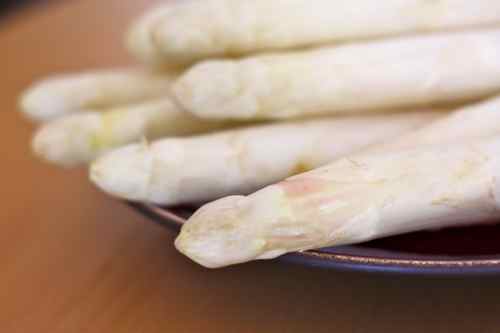
It’s here! Spargelzeit is here! What, you mean you don’t celebrate asparagus time where you live?
The Germans are crazy about white asparagus, a special breed that grows underground and is only harvested for a couple months each spring. Restaurants have special menus featuring white asparagus done every which way, and all the fruit and veggie stands display big piles of it, as if it’s the only thing worth eating this time of year. Preparing this Teutonic vegetable is relatively easy, but there are a few things you should know before doing it for the first time.
Buying Spargel
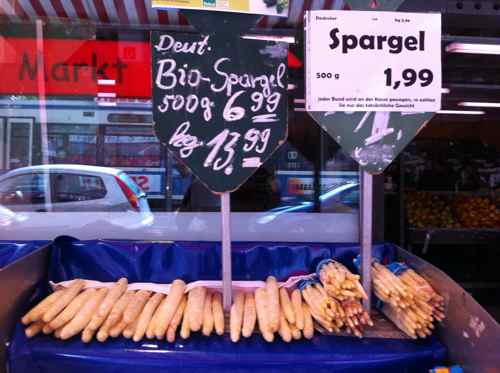
You want fresh stalks with tight, compact heads. Look at the cut end of the stalk to gauge freshness – if it is very dry, split and woody, you don’t want it. Prices for the best asparagus can be quite high, over €12/kilo, but during the middle of the season you can pick up some good asparagus for much lower than that.
Unlike most vegetables, smaller is not better when it comes to white asparagus. Don’t shy away from stalks with a larger diameter – they are generally considered to be higher quality than small ones, and they are definitely easier to peel.
If the place where you’re buying asparagus offers to peel it for you (sometimes there’s a machine, and sometimes a cute old lady does it), by all means take them up on it, as long as you plan on eating the asparagus the same day. This will save you a lot of labor in the kitchen.
Prepping Spargel
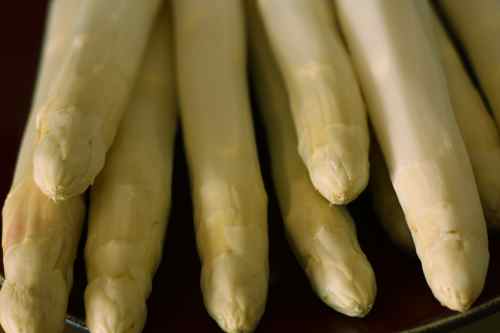
This is where you’ll be thankful you didn’t go for those tiny stalks. Use a vegetable peeler to peel the entire outside of the white asparagus except for the head (you can start a couple centimeters below the head and be fine). Be gentle – the stalks are delicate. Some people recommend cradling the stalk in your forearm as you peel, but I find it’s easier to just hold them in my hand, without gripping too close to the head. You’ll also want to chop a little off the cut ends – just a centimeter or so, depending on how fresh it looks. Try to get all the split, woody-looking part off. Don’t use the snapping method that is sometimes recommended for green asparagus – you’ll end up wasting a lot of the good part of the white asparagus if you do that.

Cooking Spargel
This is where things get easy again: treat the white asparagus like any other vegetable that needs to be cooked to a certain softness (like green asparagus, broccoli, or carrots). I usually steam or roast my spargel; boiling is quick and easy, too.
Serving Spargel
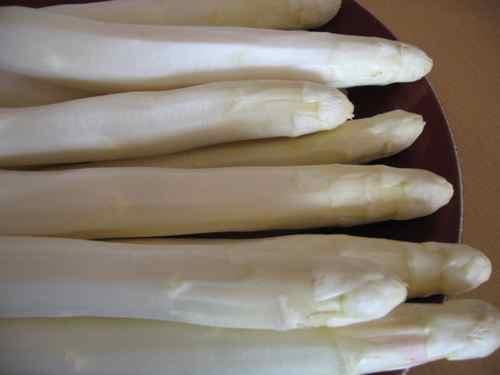
Once I’ve gone through all that effort to make white asparagus, I want to actually taste it, so I usually serve it rather simply: with a squeeze of fresh lemon juice and a dash of salt and pepper. You can also drizzle a little olive oil on, or grate a little parmesan cheese over it, or serve it with Hollandaise sauce. If you have broken, less attractive stalks, you can make a white asparagus risotto or white asparagus soup with them.
So, how do you like your spargel?
Not to be too blunt about it, but in my recipe book there’d be a last step in your recipe:
Take entire bunch of Spargel and compost it! 🙂
My wife is careful only to cook it when I’m not around. Even the smell of it gives me the heaves.
I found this fascination with white asparagus so unusual when I arrived here two years ago. I bought it, prepared it, and we tasted it and it was such a letdown. It is asparagus. White or green, it is still asparagus. Don’t get me wrong, I like it, but why don’t the Germans celebrate other vegetables or fruits like they do asparagus? It all has me quite confused…this fuss over a vegetable. And I could never pay up to €12 for a vegetable. Quite fascinating.
Ok since my last Spargel-related comment I have done my best giving it another go and have to say I am now COMPLETELY in love with the white stuff. I cannot get enough of it. I even smuggled some back to London for my parents and friends to try it last week. HEAVEN.
“Stalks with tight, compact heads”, “woody”, “smaller is not better”.
Perhaps I’m in a suggestible mood, but I must excuse myself for about three-and-a-half minutes.
@Ian – Perhaps you could choose a different vegetable to celebrate? Start campaigning for the recognition of Karottenzeit or Zucchinizeit…
@expat – Agreed that the fuss is quite amusing and baffling – if I were going to choose one vegetable to get all excited for, it wouldn’t be asparagus. But I still enjoy eating it a couple times a season.
@HH – You popped into my mind several times while I was composing this post. You should have seen the earlier version of the sentence about gripping the stalk firmly below the head.
@Frau Dietz – LOL, I’m impressed with your total turnaround on the topic of spargel. Enjoy!
Hi! Here from ILCW. I like my spargel the Dutch way: with ham, eggs, (new) potatoes and butter sauce. Simple but oh, so delicious. 😉
Drizzle some olive oil over it, add a dash of your favorite seasoning (I like salt, pepper and rosemary) then put it in a roasting pan and roast it. Mmm. That’s the best way. And I know it is the best way, because when we lived in Zürich and served it to Germans & Swiss, they always asked for the recipe!
Also works with green asparagus.
Great post! Thanks! And now I am hungry!
I’ve learned something new – I’d always thought that white asparagus was basically the green stuff but kept underground as it grew (as with much German cuisine, it was also a big deal in Alsace. I always enjoyed it, and miss it now, but couldn’t get quite as excited by it as the locals).
Oooh, you did not only make me hungry and salivating with this post but also homesick!!!
Hi Julie! I am Joanna, and participating for the first time in ICLW.
I lived in Germany for 16 years but moved here in the Netherlands 2 years ago. While I was an apprentice in a hotel in Germany, I had to go through different departments and the kitchen was not an exception. It was the season of asparagus as I had my turn to do kitchen duties. Well, it was a lot of work but I was glad to learn.
Not only because I am now living in Holland do I prefer Hollandaise sauce on my asparagus but I have loved it ever since I tasted it for the first time.
(3/87 ICLW(
Huh, I have never seen white asparagus before. So interesting…and yummy! It must be fascinating living in another country. I am very envious.
Happy ICLW!
Mmmm, I am enjoying all these spargel serving suggestions. This weekend we picked up some white asparagus with purple tips – purple because they had just barely been exposed to the sun. Because of this “flaw” they are slightly cheaper, but still just as tasty.
I really miss the white Spargel. I can get them here, but they are very thin and often not as fresh as I’d like them to be. I’m not sure which way I like them best. Delicious with ham, hollandaise or with a bit of browned butter and parmesan. Mmmm.
Cerebrating the white asparagus season is more to do with cerebrating the end of the long winter. I grew up in Belgium. Belgians do cerebrate the white asparagus season as much as the Germans do, which I totally understand given their looooooooong gloomy winter….
Flemish Style is my favourite. Chop firmly boiled eggs, add melt butter, lemon juice, and finely chopped parsley, put them on the top of boiled white asparagus. This is heaven!!
Btw, I saw an asparagus pan in US. They are equally crazy about green asparagus??
@Sandra – You’ll have to time your next visit to Switzerland to coincide with Spargelzeit, then. 🙂
Sachiko – I never thought of it as a celebration of the end of winter. Interesting. And I have to try them Flemish style next time.
There’s definitely no asparagus craze in the US, for green or any other color. There’s more of a kitchen gadget craze, I think.
I had my first spargel of the season tonight. Mmm! We like it the traditional way, with potatoes, speck, and hollandaise, but we also often make it in a risotto topped with fresh rucola.
Some nice commercial of a supermarket chain about white aspargarus:
http://www.witzige-werbespots.tv/spotanschauen.php?werbespot=7997